In August 2014, I noticed a potential security vulnerability in relation to the .mil top-level domain, which is operated by the US military. As such, I reported the issue to CERT, describing the issue in sufficient detail that they could understand the problem.
about the report in the Financial Times concerning millions of US military emails being misdirected, and quote-tweeted that I had reported the issue many years ago:
Elliot Silver later blogged about it, and it's been reported on by many other news outlets.
You can read my August 6, 2014 CERT "Vulnerability Report" here (I had prudently saved a copy), and the confirmation was VRF#HYIXW4Z4. [The PDF is redacted, as it had contained my cell phone number, which I rarely disclose.]
Not only do they dismiss comments and concerns relating to the changes in the RRA, which we wrote about extensively. ICANN staff went even further, and LIED about past comment submissions! At the bottom of page 13, they wrote:
ICANN, the organization that regulates global domain name policy, and Verisign, the abusive monopolist that operates the .COM and .NET top-level domains, have quietly proposed enormous changes to global domain name policy in their recently published "Proposed Renewal of the Registry Agreement for .NET", which is now open for public comment.
Either by design, or unintentionally, they've proposed allowing any government in the world to cancel, redirect, or transfer to their control applicable domain names! This is an outrageous and dangerous proposal that must be stopped. While this proposal is currently only for .NET domain names, presumably they would want to also apply it to other extensions like .COM as those contracts come up for renewal.
ICANN has a public comment period for the Final Report from the EPDP on Specific Curative Rights Protections for IGOs, which proposes to harm registrants' rights, by making IGOs (intergovernmental organizations like the UN) exempt from the mutual jurisdiction clause of the UDRP/URS. This would mean that a domain owner's rights to judicial review of an adverse UDRP/URS decision would be prejudiced.
I've written extensively about the security implications of the "Losing FOA" step of domain name transfers. It's the opportunity for registrants to "ACK" or "NACK" a pending transfer, before it completes. I wrote about this again yesterday, and that post linked to all prior writings.
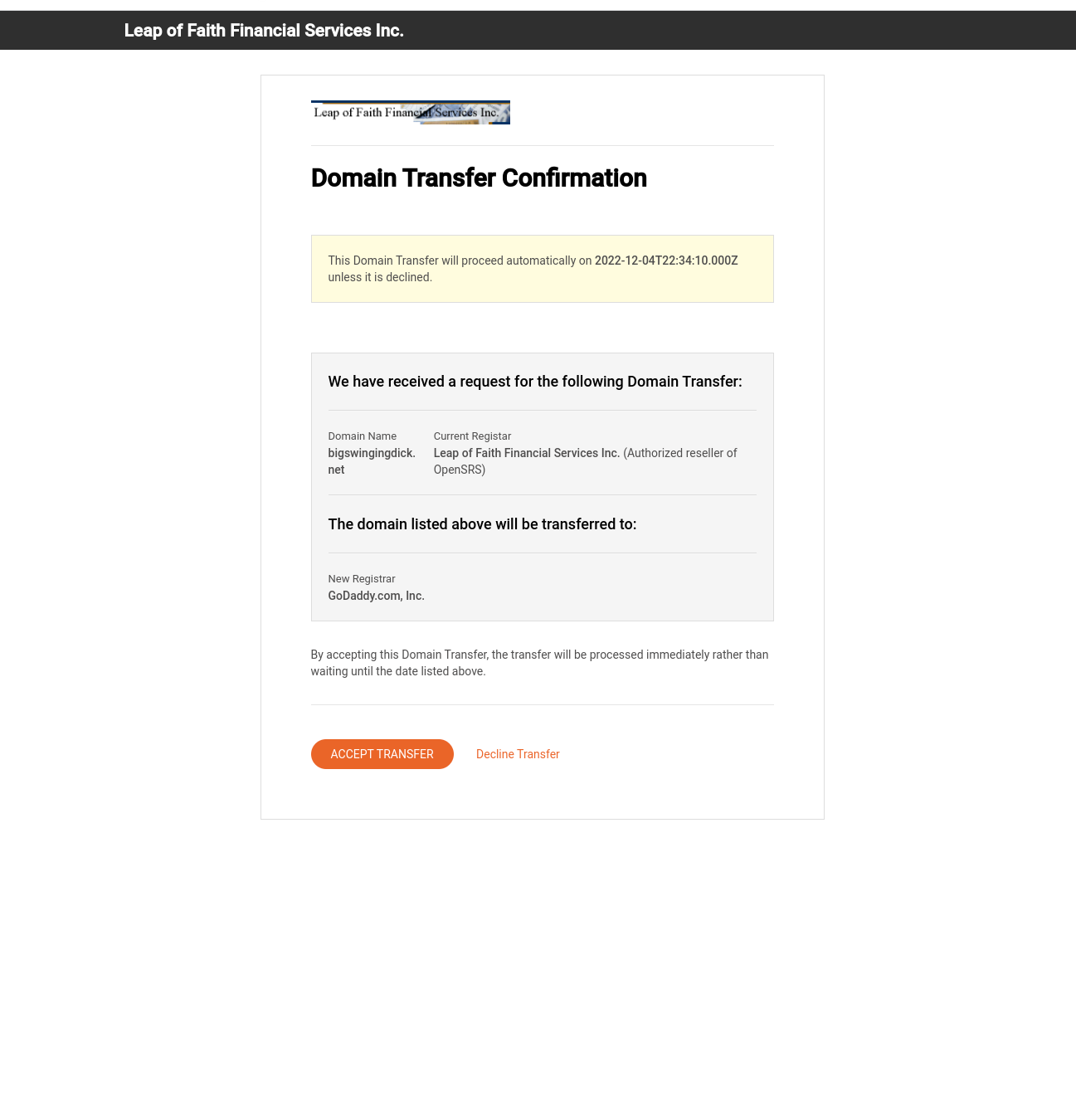
I wanted to give readers direct visual evidence of why the Losing FOA is so important as a security mechanism, so I intiated a transfer of a domain name from my company's portfolio at Tucows/OpenSRS to GoDaddy. After I input the transfer code (currently called the “AuthInfo Code”, but it will be renamed the “Transfer Authorization Code” or “TAC”) at GoDaddy, Tucows/OpenSRS sent me (as registrant) an email, with a link to a page that would allow me to immediately approve the transfer (i.e. "ACK" it), or to reject the transfer ("NAK" it). Here's a screenshot:
Example of OpenSRS Losing FOA page, allowing registrants to accept or reject an outgoing transfer request
As you can clearly see, the page contains text saying:
The domain name listed above will be transferred to:
New Registrar GoDaddy.com, Inc.
and gives me the opportunity to accept the transfer, or decline it (I've just left things in a pending state for now; I'll perhaps "ACK" the transfer in a few days).
I’d written multiple blog posts before then, warning about the negative ramifications should their recommendations be adopted. See here, here, here, here and here for those past articles on the topic.
As I've yet to be invited to participate directly in that working group (which might correct the severe unbalanced and unrepresentative participation, where registrants' views are not being taken seriously), I've written a public response to that email. You can read that response here (while it's 20 pages long, it's very generously spaced, so it shouldn't take long to read and digest).
There is a lot wrong with this working group's report and ongoing deliberations. The public deserves more than mere lip service during an ICANN75 meeting. We deserve active engagement throughout the remainder of the working group's efforts, especially given the unbalanced participation at present.
Remote participation is available via Zoom (you'll need to create an ICANN account to access the links to the Zoom room, as per the above session link).
As I've noted in my lengthy comment submission, there are very serious problems with the working group's recommendations.
Furthermore, that working group's review of the public comments is superficial at best. As an example, watch the Zoom recording of this past Tuesday's working group call. (unfortunately, the written transcript of the call isn't posted yet on the GNSO's calendar page).
Did the working group even mention, in discussions of removal of the Losing FOA, my citing of the SSAC report, from page 39 of my comment submission, to:
"Treat transfer attempts as a security event (check and re-check)."
Nope! Apparently such an important point was not worth mentioning on their call! It demonstrates the importance of the Losing FOA.
There's a certain arrogance in the working group, as if they know better than the public. e.g. Jim Galvin of Afilias (a member of the SSAC) claimed he was "not especially persuaded by most of these comments" and that he didn't believe "that there's new information here" (see the "rough transcript" produced by Zoom at around 44:22 into the call, or listen to the actual call; the rough transcript isn't perfect).
Galvin claimed that he "could sit here and go through, and I think I would have a specific response to each one of these comments" (at around 44:53 into the call). I openly challenge him to do so!
I even reached out to him, to have a telephone call, to go through my concerns to see what his "response" would be. I've not heard back, yet.
At 1 hour and 10 minutes into the call, Galvin asserts that "there really is no diference between the FOA and the notification." He then goes on to claim "the notification has the same properties. It neither adds nor removes them."
This is demonstrably false!
If I validly create a TAC (transfer authorization code), to transfer a valuable domain name from Tucows to GoDaddy (as an example), and provide that TAC to a buyer or to an escrow company, but then see (via the Losing FOA) that the transfer is actually going to Alibaba or a Russian registrar, I'd be able to NACK (cancel) the transfer, as it's not going to the correct destination.
That involved no compromise of the registrar's control panel, but involved misuse of the TAC after it was properly generated, but before it was properly used at the correct gaining registrar).
This is a perfect demonstration that their analysis is completely wrong. The removal of the Losing FOA would have demonstrably made one worse off.
Galvin claims that "all bets are off" if an attacker gains access to a registrar's control panel (because the attacker can change registrant contact details, so the registrant wouldn't be able to receive the Losing FOA). Again, his analysis is wrong. Perhaps at a poorly-designed registrar, his analysis might be fine. But, a properly-designed security-conscious registrar wouldn't immediately make those critical changes. They would seek verification first! I documented in my lengthy submission that I carefully separate out the registrar control panel details and contacts, so that they're independent of the domain name contacts.
Later on that call, at around 1 hour and 14 minutes, Jim Galvin demonstrates to us all that he didn't actually do his homework and understand the working group's report, as he was unaware that the 5 day window after the gaining registrar submits the transfer was being eliminated. How embarrassing for him, and embarrassing for SSAC. He says "maybe I'm missing something here" -- yes, Galvin and others are missing a lot!
In conclusion, it's clear that these working group members are not doing a proper review of the public comments. They have tunnel vision, and are working from the starting point that they "know better" than the public who submitted serious concerns about their dangerous proposals. If you share these concerns and have time on Friday night (North American time) to attend the ICANN75 session remotely, please do so.
1. Pace’s use of the celluvation.com domain does not violate the ACPA. 2. Pace's use of the celluvation.com domain does not violate the Lanham Act. 3. Pace has established a claim for reverse domain name hijacking. 4. Defendant’s counterclaims against Plaintiff are DISMISSED WITH PREJUDICE for willful and inexcusable failure to prosecute and failure to comply with court orders pursuant to Fed. R. Civ. P. 41(b). 5. Pace’s request for fees is DENIED. 6. The WIPO arbitration panel decision is OVERTURNED, and the domain name registrar for celluvation.com is ORDERED to lift the hold on the domain name and return the domain to Pace. 7. Judgment shall be entered in favor of Plaintiff